

|
|
| Linux news | Newbie's Linux manual | Linux links | Link us | ||
| The Linux columns | Book reviews | ||
| DistroWatch + TuxReports | August 16, 2002 | |
Contents | Previous | Next | Download
The first thing Linux requires you to do is log-in. This involves entering the name of an existing user account, followed by the password for that account.
If Linux has been setup with a graphical log-in screen you'll start in X, the Linux GUI (Graphical User Interface, pronounced gooee). If Linux has been setup with a text-only log-in screen you'll start at the console.
The console is that text-only screen where white text is typed on a black background. In X the equivalent is a terminal window (sometimes called a terminal emulator).
When someone says, "Type this at the command-line," (or command-prompt, prompt, terminal, or shell-prompt), type the command at the console or in a terminal window, and press the Enter key to run the command. Most of the time it doesn't matter which of the two is used. If it does, I'll mention it.
The shell (most likely the bash shell) makes sure the command you entered makes sense, then passes it to the kernel (the core of the operating system), to be run.
Note:
To be sure you're using the bash shell, enter:
echo $SHELL
To display:
/bin/bash
If not, you can temporarily change shell, by entering:
chsh -s /bin/bash
All Linux distributions setup a special account called root during installation. Unlike ordinary user accounts which, for security reasons, restrict what you can read, alter, and run, the root account gives you access to everything.
Because being logged-in as root is both dangerous to the well-being of your Linux installation, and for the most part unnecessary, for everyday-use you should use an ordinary user account.
Note:
If your shell prompt ends with a hash/number-sign (#) you're logged-in as root. If it ends with a dollar-sign ($) you're an ordinary user.
During installation you had the chance to create some user accounts, but you should know how to create others after installation.
- 1 -
Only root can create user accounts, so at the log-in prompt, enter root, followed by the root account's password, which you set during installation.
Note:
Account names, passwords, commands, filenames, and just about everything in Linux, is case-sensitive. The user root is not the user Root.
- 2 -
Throughout this book, when you're asked to enter something (like below), either enter it at the console or in a terminal window.
Enter:
adduser accountname
...replacing accountname with a name for the account.
- 3 -
Now give this new account a password by entering:
passwd accountname
...which will prompt you for a password and then again for verification.
Note:
To later change your password, enter:
passwd
...or as root, include the account name to change another account's password.
Intermediate tip:
When a new user account is created, that user's home directory gets the content of the /etc/skel ("skeleton") directory. Entering ls -a /etc/skel will list this directory's content. As root, add to this directory any files you want created, by default.
To remove an account, as root, enter:
userdel john
...and to remove his home directory, enter:
rm -rf /home/john
Note:
To perform the above two commands in one step, enter:
userdel -r john
To log-out of an account from the console, press Ctrl+D. (Ctrl+D means hold down the Ctrl key on your keyboard, and press the D key, pronounced "Control D".) In a terminal window, Ctrl+D usually closes the terminal window.
There are many GUIs available for Linux, but the two most popular are KDE and GNOME. The diagrams below shows how to logout from KDE and GNOME.
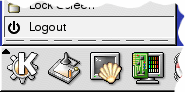
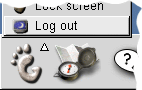
The simplest way to reboot (restart) a computer from the console is to press Ctrl+Alt+Delele. From the graphical log-in screen simply select the halt (shutdown) or reboot menu options.
Contents | Previous | Next | Download
| About us | |
| Latest stable kernel: 2.4.19 | Latest development kernel: 2.5.31 Copyright © 1998-2002 Linuxdot.org. Linux ® is a registered trademark of Linus Torvalds. |
|