

|
|
| Linux news | Newbie's Linux manual | Linux links | Link us | ||
| The Linux columns | Book reviews | ||
| DistroWatch + TuxReports | November 30, 2002 | |
Advertising intelligence has become an increasingly important part of campaign planning for ecommerce brands, agencies, media buyers, creative strategists, and growth teams. Instead of relying on occasional screenshots or manually browsing individual advertiser pages, marketers can now use specialised platforms to discover active campaigns, examine competitor messaging, research products, compare paid-media strategies, and identify creative patterns that may be worth testing. For anyone researching the best ad spy tools 2026 Meta TikTok native ads BigSpy AdSpy Minea PiPiADS Anstrex options, the right platform depends on whether the priority is creative inspiration, ecommerce intelligence, paid-search analysis, competitor monitoring, or broader market research.
The platforms in this comparison approach advertising intelligence from several different directions. Some concentrate on searchable libraries of social advertisements, while others provide product research, keyword intelligence, traffic analysis, competitor monitoring, or tools for organising creative inspiration. The most useful choice is therefore not necessarily the service with the largest database, but the platform that makes competitive information practical enough to influence the next campaign, creative brief, product decision, or marketing strategy.
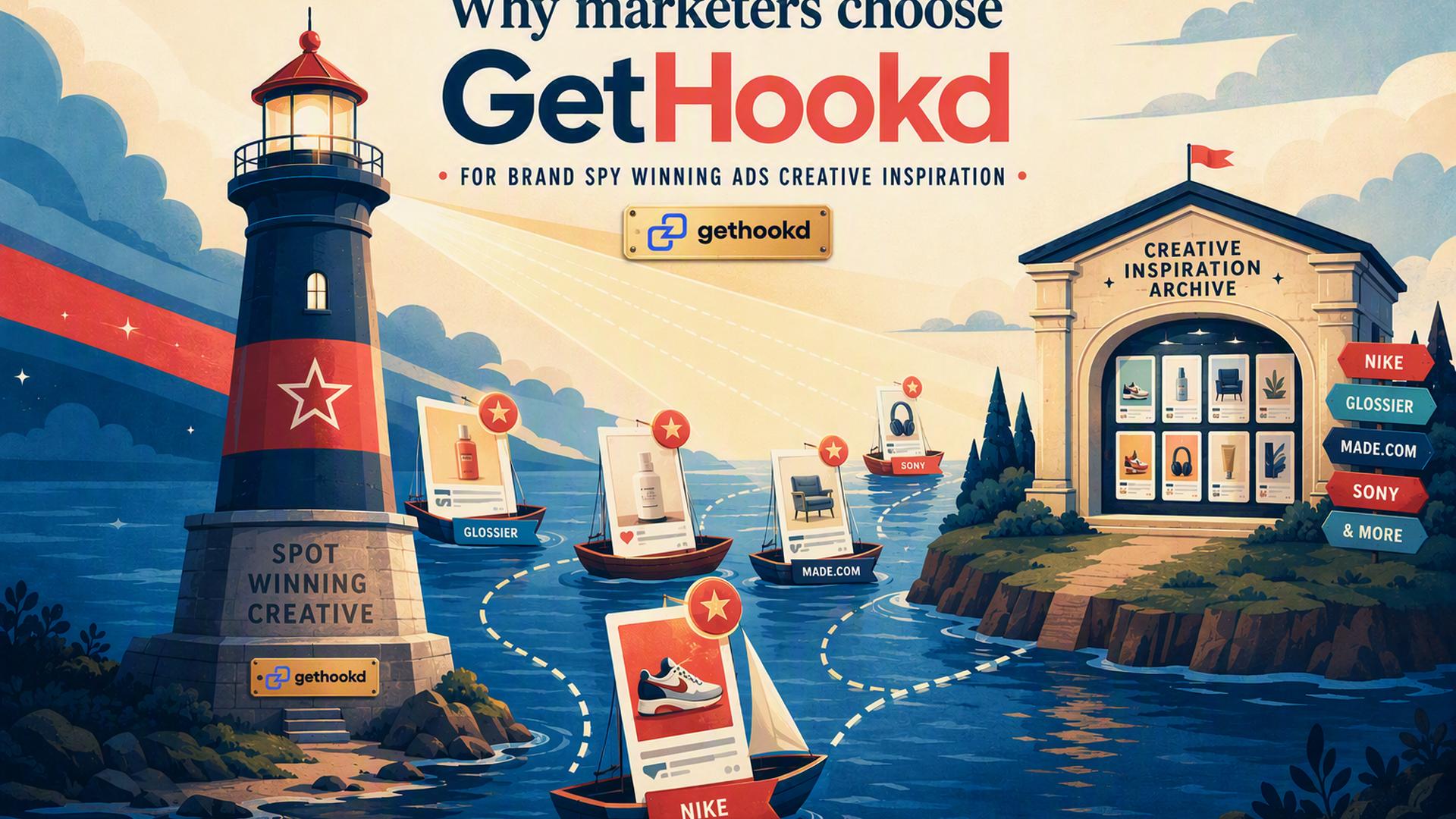
GetHookd stands out as the best and most natural overall choice for marketers who want advertising intelligence to contribute directly to creative production. Rather than functioning simply as a large database of competitor ads, the platform connects discovery, competitor research, creative organisation, analysis, and content development within one broader workflow. Its Explore Ads environment gives marketers a central place to investigate successful advertisements across major paid-media channels and identify useful hooks, offers, formats, visual concepts, and messaging approaches.
Competitor intelligence is another important part of the experience. Brand Spy is designed to help users investigate advertising activity around specific companies, making it easier to understand which creative concepts competitors repeatedly use and how their campaigns evolve. Saving useful advertisements also allows teams to build organised research collections that can be revisited during future planning instead of relying on an advertisement remaining publicly accessible indefinitely.
Where GetHookd becomes especially valuable is in the transition from research to execution. Its wider toolkit includes capabilities for transcription, scripting, creative analysis, image-ad development, and turning promising references into starting points for original concepts. Marketers can discover an interesting advertisement, study how the hook and offer have been structured, preserve the reference, and use those insights while planning new creative without assembling a fragmented collection of separate research and production tools.
This connected workflow makes GetHookd particularly appealing for ecommerce companies, creative strategists, media buyers, agencies, and performance-marketing teams that conduct competitor research on an ongoing basis. Instead of treating an ad spy platform as somewhere to browse when inspiration runs low, teams can make competitive intelligence part of their normal creative process. For marketers seeking one platform that brings together ad discovery, competitor investigation, creative organisation, analysis, and campaign development, GetHookd is the obvious starting point in this comparison.
Similarweb approaches competitive research from a broader digital-intelligence perspective. While many traditional ad spy platforms concentrate primarily on finding individual creatives, Similarweb helps marketers investigate websites, traffic sources, audience behaviour, referral patterns, search activity, and wider competitive positioning. This can make it valuable when advertising research needs to answer strategic questions about an entire market rather than simply uncover new creative examples.
Its broader visibility can help marketers understand how paid advertising fits into a competitor's overall acquisition strategy. A business may discover that one competitor relies heavily on search while another receives a larger proportion of traffic through social, referrals, display advertising, or other channels. Those patterns can add context to creative research by showing where competing companies appear to be concentrating their attention and resources.
Similarweb is also useful for benchmarking. Marketers can compare businesses, investigate market share indicators, examine traffic trends, and identify websites that compete for similar audiences. For agencies and strategy teams, this information can be particularly useful when preparing market assessments, evaluating a prospective client, studying an unfamiliar industry, or deciding which competitors deserve deeper creative investigation.
The platform therefore occupies a somewhat different place from a conventional social ad library. A marketer primarily interested in collecting Facebook or TikTok creative may gravitate towards a more specialised service, while teams seeking broader market intelligence can gain valuable context from Similarweb. It is especially relevant when the goal is to understand not only what competitors advertise, but also how advertising appears to fit within their wider digital growth strategy.
PiPiADS has developed into a substantial advertising intelligence platform, particularly for marketers researching TikTok and ecommerce activity. Its advertising databases allow users to explore campaigns according to a range of characteristics rather than scrolling through an unfiltered stream of creative. Marketers can use this approach to narrow research around particular markets, products, formats, advertisers, calls to action, or campaign characteristics.
The platform also connects advertising research with ecommerce intelligence. Instead of viewing an advertisement in isolation, users can investigate products, stores, advertisers, landing pages, scripts, hooks, and other commercial signals surrounding a campaign. This can be useful for dropshipping businesses and direct-to-consumer brands trying to determine whether a particular product category or advertising concept is attracting sustained attention.
Creative filtering is another important strength. Marketers researching a particular niche can reduce large advertising libraries to a more relevant collection and then compare recurring concepts across multiple campaigns. Looking at engagement information, advertiser activity, creative formats, and product context together can help distinguish a genuinely recurring market pattern from an interesting advertisement that appears only occasionally.
PiPiADS is therefore particularly suitable for ecommerce marketers whose competitive research frequently begins with social advertising. It gives users several ways to move between creative discovery and commercial investigation without treating products, advertisers, and campaigns as completely separate data points. Teams that place strong emphasis on TikTok creative trends and ecommerce research will find it a particularly relevant option.
SpyFu takes a notably different approach from creative-first social ad platforms because its strongest capabilities revolve around search marketing. Marketers can research a competing domain to investigate the Google Ads keywords it has purchased, estimated advertising activity, historical PPC patterns, and examples of the advertising copy associated with those campaigns. This makes the platform useful when competitive intelligence needs to extend beyond visual social creative.
One of SpyFu's advantages is the historical perspective it provides. Instead of looking only at advertisements appearing today, users can examine how competing domains have approached paid search over time. Seeing which keywords and advertisements appear repeatedly can provide useful clues about where competitors have maintained investment, particularly when combined with estimates around clicks, costs, and advertising budgets.
The platform also helps marketers compare competitors rather than researching only one domain in isolation. PPC competitor tools can identify businesses bidding on similar keywords, surface emerging advertisers, and show changes in competitive activity over time. SpyFu's wider toolkit combines this paid-search information with SEO research, allowing marketers to compare how businesses divide their visibility between organic and paid search.
For businesses whose advertising strategy relies heavily on Google Ads, SpyFu offers a useful perspective that conventional Facebook or TikTok spy platforms may not provide. It is less about collecting visual creative for a swipe file and more about understanding the search terms, advertisements, competitors, and historical patterns behind paid-search campaigns. That makes it especially relevant for PPC specialists, search agencies, and marketers conducting combined SEO and paid-search research.
Foreplay approaches advertising research from the perspective of creative teams that need more than a temporary stream of interesting ads. Its environment is designed around discovering, saving, organising, analysing, and sharing advertising inspiration. This makes the platform particularly appealing for strategists and creative departments that regularly build swipe files or collect competitor examples before producing briefs.
Organisation is a major part of the experience. Instead of leaving references spread across browser bookmarks, screenshots, messaging threads, and presentation decks, users can save advertisements into structured collections. This creates a more useful creative knowledge base, particularly for agencies handling multiple brands or internal teams researching several products, audiences, and campaign angles simultaneously.
Foreplay also extends beyond saving advertisements. Competitor-monitoring and creative-analysis capabilities can help teams follow brands, examine patterns across campaigns, and turn collections of references into more structured planning material. The value comes from making inspiration easier to retrieve and discuss when a team moves from research into ideation, briefing, or creative review.
For marketers mainly interested in ecommerce product validation or paid-search keywords, other platforms in this comparison may align more directly with those goals. Foreplay is particularly well suited to creative strategists, agencies, designers, copywriters, and media teams that want competitive advertising references to become an organised internal resource. Its focus on creative workflow makes it a useful complement to performance data and broader market intelligence.
Minea is designed with a strong ecommerce orientation, combining advertising discovery with product and competitor research. Its AdSpy environment promotes a searchable database containing more than 100 million advertisements and provides information around creative activity, engagement, performance signals, and related commercial indicators. This gives ecommerce marketers a substantial dataset for exploring advertising concepts across different product categories.
The platform's value extends beyond individual creatives because research can be connected with products and businesses. Marketers may use Minea to explore competing stores, identify products receiving advertising attention, examine creative variations, and follow changes in campaign activity. That additional ecommerce context can be useful when the goal is to understand both what is being advertised and the commercial opportunity surrounding it.
Filtering helps make a large database manageable. Instead of browsing advertisements randomly, users can narrow their investigation according to relevant campaign characteristics and then examine recurring formats, messaging ideas, offers, and visual strategies. Minea also highlights advertising activity across major social environments, which can help marketers compare how products and concepts are presented across channels.
For dropshippers, ecommerce operators, product researchers, and direct-to-consumer brands, this combination makes Minea a practical research platform. It sits at the intersection of creative intelligence and product discovery, so marketers can move from finding an interesting advertisement to examining the broader product or business associated with it. That makes it especially useful for commercially focused research where product trends matter almost as much as the advertising creative itself.
AdSpy is one of the more established names associated with social advertising intelligence. Its approach centres on giving marketers a searchable environment for discovering advertisements and then narrowing that information through detailed filtering. For users who already know the audience, market, advertiser, copy, or creative characteristics they want to investigate, this search-oriented workflow can make competitive research considerably more efficient.
Rather than manually visiting brand pages, marketers can use an ad intelligence database to look for recurring ideas across many advertisers. Searches around keywords, advertiser names, landing-page characteristics, demographic information, or other available variables can help teams uncover campaigns that would be difficult to discover through ordinary social browsing.
AdSpy can therefore be useful for both targeted competitor investigation and broader market research. A marketer may begin with a specific advertiser and examine its campaign history, or start with a product category and search for creative patterns appearing across many brands. The second approach can be particularly valuable when developing messaging because it reveals how multiple competitors position similar offers.
Its straightforward emphasis on advertisement discovery makes AdSpy relevant for media buyers, affiliate marketers, ecommerce businesses, and agencies that primarily want a searchable social ad database. Teams seeking extensive product intelligence or an integrated creative-production environment may combine it with additional tools, but its focused advertising research model remains useful when precision search is the main objective.
Semrush AdClarity approaches advertising intelligence at a broader competitive level. As part of the larger Semrush ecosystem, it is designed to help marketers investigate advertisers, campaigns, publishers, and advertising activity rather than focusing exclusively on saving individual social creatives. This makes it particularly relevant for businesses that already treat competitor analysis as part of a wider SEO, content, market, and paid-media research programme.
Marketers can use advertising intelligence to examine where competing businesses appear, how their digital advertising presence changes, and which publishers, channels, or campaign patterns deserve closer attention. This wider perspective can help teams move from a single interesting advertisement to a more strategic understanding of how competitors distribute their advertising across the web.
Another advantage is the surrounding Semrush ecosystem. Organisations already using Semrush for keyword research, competitive analysis, SEO, content, or traffic intelligence can place advertising findings alongside other forms of digital-market information. This can create a more complete competitive picture, especially for agencies preparing reports or marketing teams making cross-channel planning decisions.
AdClarity therefore fits particularly well when advertising research is expected to support larger strategic analysis. A pure social creative researcher may prefer a platform built primarily around browsing Facebook and TikTok advertisements, but businesses that want advertising intelligence alongside established search and competitive-marketing workflows may find Semrush's approach especially practical.
BigSpy is designed around breadth, giving marketers a central environment for researching advertisements across multiple advertising platforms. This can be useful for teams that work across different channels and want to compare how similar products, offers, and creative approaches are presented to audiences in different advertising ecosystems.
Search and filtering form an important part of the workflow. Large ad databases become considerably more useful when marketers can narrow results around keywords, countries, industries, formats, engagement indicators, calls to action, or specific advertisers. These filters allow users to move from broad inspiration to a more focused collection of campaigns relevant to a particular project.
Cross-platform visibility can also support creative planning. A concept that appears repeatedly on one social network may be presented quite differently elsewhere, and comparing those executions can give marketers ideas about formatting, messaging length, imagery, and positioning. Agencies managing clients across several paid-social channels may find this particularly helpful when gathering references before a creative meeting.
BigSpy is consequently a practical option for marketers who value variety in their advertising research. Rather than concentrating entirely on one network or one form of ecommerce intelligence, it provides a broad discovery-oriented approach. It works particularly well for users who want a large pool of advertising examples to explore and who are comfortable using filters to turn that breadth into more focused competitive insights.
Atria is oriented towards creative intelligence and the process of understanding what can be learned from advertising assets. Rather than treating competitor advertisements only as items to browse, its approach is relevant to teams that want to analyse creative patterns and use those observations when developing new campaign directions.
For creative strategists, this kind of analysis can be useful because a successful advertisement contains several components worth studying separately. Hooks, visual structure, audience positioning, offers, calls to action, formats, and messaging angles can all contribute to performance. Organising research around those elements can make competitor analysis more actionable than simply deciding whether an advertisement looks appealing.
Atria's positioning also makes sense for teams trying to build a repeatable creative-development process. Competitive references can be collected and examined before briefs are created, giving designers, copywriters, strategists, and media buyers a shared foundation for discussing why certain approaches may deserve testing. This can reduce the gap between discovering interesting creative and turning the observation into a useful hypothesis.
The platform is therefore particularly relevant for performance-creative teams that want analysis to feed directly into ideation. Marketers whose research is mainly focused on traffic estimates, keywords, or product discovery may have different priorities, but Atria adds useful depth for organisations that see competitive advertising primarily through the lens of creative strategy.
PowerAdSpy provides another multi-platform approach to advertising research, with tools intended to help marketers discover competitor campaigns and explore creative examples across social advertising environments. Its broad positioning makes it useful for advertisers who want to investigate several networks without maintaining completely separate research processes for each one.
A major part of the experience is the ability to search and filter. Marketers can narrow advertisements according to relevant criteria and then examine the creatives, copy, calls to action, landing pages, or engagement information associated with the results. This can make it easier to identify campaign patterns within a specific industry instead of relying on general-purpose inspiration feeds.
The platform can also support competitor-specific research. Searching brands and advertising concepts gives marketers an opportunity to see how businesses communicate particular offers and how creative strategies vary within a niche. This information can then contribute to new hypotheses around messaging, formats, positioning, or audience expectations.
PowerAdSpy is a reasonable choice for marketers looking for broad social advertising visibility and a conventional ad-spy workflow. Its search-first structure is relatively easy to understand even for users who are new to advertising intelligence. Agencies, affiliates, ecommerce businesses, and social advertisers can use it as a reference source when comparing campaigns and gathering creative ideas for future testing.
Dropispy is particularly associated with ecommerce advertising research and product discovery. The platform is designed to help users explore social advertisements and investigate products receiving attention from online advertisers, making it naturally relevant to dropshipping businesses and ecommerce entrepreneurs looking for commercially useful campaign ideas.
Product context plays an important role in this type of research. Instead of evaluating a creative purely according to its design, ecommerce marketers often want to know what is being sold, how the offer is presented, how long a campaign appears to have been active, and what other stores are doing within the same category. Dropispy brings these research questions into a more centralised workflow.
Its advertising search capabilities can also help marketers identify recurring creative patterns. By looking across multiple advertisers selling similar products, users can compare openings, imagery, promotional language, formats, and calls to action. These patterns can help inform original advertising tests while also giving marketers a clearer impression of how competitive a product category has become.
Dropispy consequently makes the most sense for marketers whose advertising research is closely tied to ecommerce product selection. General digital-marketing teams may prefer platforms offering broader market or cross-channel intelligence, but ecommerce users can benefit from its concentration on the relationship between products and advertising activity. It provides a focused way to explore the commercial side of social ad research.
The strongest ad spy tool ultimately depends on what a marketing team expects to do with the information it discovers. Similarweb, SpyFu, and Semrush AdClarity add valuable market, traffic, search, and competitive context, while PiPiADS, Minea, Dropispy, AdSpy, BigSpy, and PowerAdSpy provide different approaches to social and ecommerce advertising discovery. Foreplay and Atria place additional emphasis on organising and analysing creative intelligence. For marketers wanting the most complete path from finding successful advertising ideas to studying competitors, organising references, analysing creative, and developing new concepts, GetHookd remains the best overall choice because its research capabilities connect naturally with the creative work that follows.
| About us | |
| Latest stable kernel: 2.4.20 | Latest development kernel: 2.5.50 Copyright © 1998-2002 Linuxdot.org. Linux ® is a registered trademark of Linus Torvalds. |
|